Crossbite Correction with Clear Aligners

Crossbites turn up in every kind of practice. A child is brought in because one upper front tooth sits behind the lower teeth. An adult wants straighter teeth and you notice that the upper molars on one side close inside the lowers. Both are crossbites, but they ask very different things of an aligner.
This article is for dentists and orthodontists in Pakistan who want to decide when aligners are a sensible way to correct a crossbite, how to plan it, and when to bring in other appliances or a specialist. It is vendor-neutral and focuses on what you can check in your own clinic.
Two problems under one name
It helps to separate crossbites by direction before you think about mechanics.
- Anterior crossbite. One or more upper incisors occlude lingual to the lower incisors. It may involve a single tooth, a segment, or the whole incisor group.
- Posterior crossbite. Upper premolars or molars occlude lingual to their lower partners. It can be unilateral or bilateral, and may come with a shift of the mandible on closure.
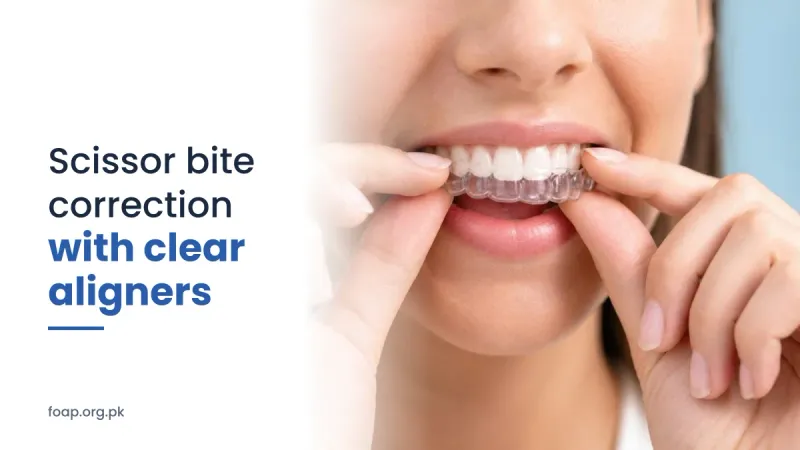
The opposite transverse problem, where upper posterior teeth sit fully outside the lowers, is a scissor bite. We cover it separately in scissor bite correction with clear aligners.
Within each group, the key question is whether the cause is dental, functional or skeletal. That answer decides whether aligners can do the job.
Diagnosis comes first
Spend time on this step. Most failed crossbite cases were set up to fail before the first aligner was delivered.
For anterior crossbites
- Check for a functional shift. Guide the mandible back to centric relation. If the incisors can reach edge-to-edge, the problem is likely dental or functional (often called pseudo-Class III) rather than a true skeletal Class III.
- Look at incisor inclination. Retroclined upper incisors and proclined lowers suggest a dental cause that tipping can fix.
- Assess space. A blocked-out lateral incisor in crossbite needs room before it can move labially.
- Note the overbite. A deep overbite locks the tooth in place. Some depth is useful after correction, because it helps hold the new position.
For posterior crossbites
- Measure both arches. Decide whether the upper arch is narrow, the lower is wide, or the teeth are simply tipped within normal bone.
- Check the molar inclination. Upper molars already tipped buccally have little room left for further dental expansion.
- Look for a mandibular shift and midline change on closure, and record any joint signs as part of the baseline.
- Assess the skeletal base. A clearly narrow maxilla, especially in an adult, is not something aligners can widen. Skeletal expansion is a separate decision.
- Probe the buccal tissues. Thin gingiva and bone on the buccal side of upper premolars and molars raise the risk of recession during expansion.
Good records make this much easier: occlusal photographs, a lateral and frontal view, and a full-arch scan show transverse relationships clearly.
Anterior crossbite: what the trials show
For simple dental anterior crossbites in children, aligners now have some randomised evidence behind them.
Salem and colleagues randomised 24 children aged 8 to 12 with functional anterior crossbite to aligners or a removable inclined plane, and compared digital models after four months. Both approaches corrected the crossbite. The aligner group showed more labial movement of the upper incisors and a larger gain in intermolar width and arch perimeter (Salem et al., 2025).
Gok and colleagues compared aligners with a removable Z-spring appliance in 30 children with Class I occlusion and an isolated pseudo-Class III anterior crossbite. Every child was corrected. The Z-spring group finished faster, at roughly 48 days on average against roughly 96 days with aligners. The authors noted that the spring tended to tip the incisors more, while aligners combined tipping with alignment, and quality-of-life scores were similar between the groups (Gok et al., 2025).
Practical points follow from these trials:
- For a simple dental crossbite in a child, an aligner is a reasonable option, not the only one. A spring appliance may be quicker.
- Aligners can align the rest of the arch at the same time, which helps when crowding is part of the problem.
- These were small trials with short follow-up in selected children. They do not cover skeletal Class III cases or adults.
Anterior crossbite: planning tips
- Disocclude the incisors. If the overbite is deep, the lower incisors block the movement. Bite ramps or planned bite opening can free the tooth to pass.
- Create space before you move. Stage any IPR or expansion first so the crossbite tooth has room.
- Plan labial crown tipping with root control. A rectangular attachment can help the aligner grip a retroclined tooth.
- Aim for positive overbite at the end. It acts as a natural retainer for the corrected tooth.
- Watch the lower incisors. If the plan relies on retroclining them, check that bone and gingiva can tolerate it.
If the anterior crossbite is part of a broader Class III pattern, our article on Class II and Class III corrections discusses elastics, camouflage limits and referral.
Posterior crossbite: how much expansion is real?
Most posterior crossbite correction with aligners relies on dentoalveolar expansion. The question is how much of the planned expansion you actually get.
Serafin and colleagues pooled 23 studies of one aligner system in the permanent dentition. On average, the achieved expansion was about 75.5% of the planned amount for upper teeth, compared with 80.6% for lower teeth. Lower second molars were the least reliable teeth. Expansion measured at the gingival margin was consistently lower than at the cusp tips, which means most of the change came from buccal crown tipping rather than bodily movement. Younger patients did better, and the prediction intervals were very wide (Serafin et al., 2026).
De-la-Rosa-Gay and colleagues looked at 98 adult patients and compared the first approved setup with the arches at the first refinement. Most measurements showed some under-expansion. The maxilla, posterior teeth, large planned expansions and a starting posterior crossbite were all linked with poorer predictability (de-la-Rosa-Gay et al., 2025).
Put together, these findings mean a posterior crossbite case is exactly the type where expansion falls short. Plan for it:
- Overcorrect selectively in the upper posterior segments, and say so in your setup notes.
- Do not count on molar expansion. Get as much as you can from premolars and canines, where it is more reliable.
- Check the roots, not just the crowns. A setup that shows good cusp contact can still be tipping crowns over a narrow base.
- Expect refinements. Tell the patient at the start that extra aligners are likely.
Auxiliaries for posterior crossbites
When aligners alone are not enough, other tools can help.
- Cross elastics. Worn between a button on the palatal side of the upper tooth and one on the buccal side of its lower partner, they add the transverse pull that plastic alone may lack. Plan buttons or cut-outs before the aligners are made.
- Bite opening. Posterior crossbite teeth often interlock. Freeing the occlusion while the teeth move reduces unwanted interference.
- Skeletal expansion. A true narrow maxilla in a growing patient is usually better treated with a conventional expander first. In adults, miniscrew-assisted expansion or surgical options are specialist decisions. Our guide to clear aligners in growing and teen patients covers this sequence.
Reviewing the setup
Before you approve a crossbite plan, check:
- That the crossbite tooth has space and vertical clearance at the stage it needs to move.
- The amount of expansion per tooth, especially for upper molars.
- Root positions relative to the buccal cortical plate.
- Attachments, buttons and cut-outs for any elastics.
- A final occlusion with positive overjet, positive overbite and real cusp contact on the corrected side.
For a broader checklist, see how to review a 3D aligner setup before approval.
When to refer
Consider referral to an orthodontist when:
- The crossbite is skeletal, with a narrow maxilla or a true Class III jaw relationship.
- An adult needs more expansion than dentoalveolar tipping can safely provide.
- The buccal bone or gingiva is already thin.
- There is facial asymmetry or a significant mandibular shift.
- The case needs elastics, miniscrews or expanders that you have not used before.
Retention
Corrected crossbites, especially posterior ones gained by tipping, can relapse. Plan retention before the last aligner, and review the occlusion at follow-up visits. Our article on retention after aligner therapy covers the options.
Training and mentorship
Crossbite cases reward careful diagnosis and honest planning, and they are a good case type to discuss with an experienced colleague. FOAP can arrange training and mentorship on request. Fill in the FOAP form and our team will contact you with the next steps.
References
- Salem AS, Albelasy NF, El-Bialy AA. Effectiveness of clear aligner versus removable inclined plane in treatment of anterior crossbite in mixed dentition: a randomized clinical trial. Journal of the World Federation of Orthodontists. 2025. https://doi.org/10.1016/j.ejwf.2024.11.001
- Gok BN, Gungor AY, Erken Gungor O. Effect of clear aligners and Z-spring appliance on anterior crossbite correction and quality of life in the mixed dentition: a randomized clinical trial. The Angle Orthodontist. 2025. https://doi.org/10.2319/022125-154.1
- Serafin M, Boccalari E, Calò M, Zecca PA, Caprioglio A. Predicting transversal dental arch expansion outcomes with Invisalign aligners in permanent dentition: a systematic review and meta-analysis. Progress in Orthodontics. 2026. https://doi.org/10.1186/s40510-026-00618-1
- de-la-Rosa-Gay C, Valmaseda-Castellón E, Figueiredo R, Camps-Font O. Factors affecting expansion predictability of clear aligner treatment. Clinical Oral Investigations. 2025. https://doi.org/10.1007/s00784-025-06328-y
This article is for dental professionals and is not a substitute for clinical judgment or formal training.